Call for Abstracts – 2026 IAMC Annual Meeting
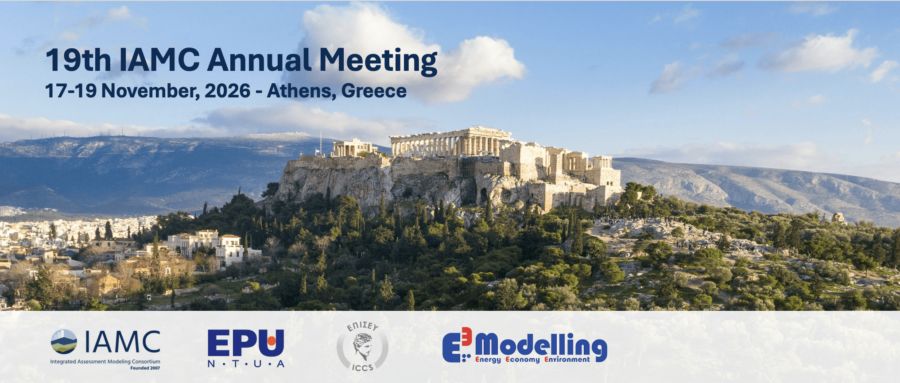
The Integrated Assessment Modeling Consortium (IAMC) announces the Nineteenth IAMC Annual Meeting to be held on November 17-19, 2026, at the Eugenides Planetarium in Athens, Greece. We invite abstract submissions for oral and poster presentations. Abstracts are welcomed across 22 thematic topics spanning mitigation strategies, energy systems, land use, climate impacts, equity, and methodological advances in integrated assessment modelling. The submission deadline is 8 May 15 May 2026, 12.00 (noon) CEST. The event will take place in person, with a portfolio of online events as part of the programme. Presentations in oral sessions (keynote sessions, and parallel oral sessions) will be held in person, with attendance both in person and online.
Abstract Topics
The IAMC solicits abstracts for oral and poster presentations on the following selected research topics:
- NATIONAL – Assessment of national mitigation strategies (including non-state actors): This session will focus on assessing the effectiveness and consequences of climate policies at the national scale, including the implementation of nationally determined contributions, net-zero targets and mid-century strategies. The session can also cover the contribution of non-state actors
- INTERNATIONAL – International climate policy: This session focuses on the implementation of international climate action in the context of UNFCCC and complementary initiatives, including the use of flexibility instruments (e.g. Art. 6) and the analysis of climate clubs. It also invites submissions on the relationship between current geopolitical developments and international climate action, including considerations related to trade and security.
- DEEP – Analysis of deep mitigation strategies: This session will focus on (the consequences of) mitigation scenarios aimed at stringent mitigation targets consistent with the Paris Agreement.
- OVERSHOOT – Strategies to decrease warming after an earlier peak: This session will look in possible overshoot strategies, including the possible climate impacts of overshoot.
- CDR – Carbon dioxide removal: This session looks into promising carbon dioxide removal techniques (CCU, BECCS, DACS, and others) and the implications of using these.
- DEMAND – Efficiency, lifestyle change, sufficiency and regrowth: This session will focus on modelling energy demand and the role of efficiency improvement. Attention will also be paid to the role of behavioral change, degrowth and its representation in IAM models.
- SECTORAL – Climate mitigation in different sectors: This session focuses on the Integrated assessment of pathways to carbon neutrality in the transport, building and industry sectors. Please note that there is a separate section on CE and materials.
- MATERIALS – Critical minerals, bulk materials and circular economy: This session will look into the material demand of baseline and transformation scenarios, as well as means to mitigate demand for materials.
- ENERGY – Energy supply-sector analysis (including fossil fuels): The session will investigate the advanced analysis of electricity and hydrogen production (including system integration) and the use of these energy carriers in end-use sectors.
- LAND&BIO – Land use and biodiversity: This session will focus on strategies related to land-related climate and sustainable development problems, including biodiversity conservation, ecological services and land degradation.
- FEASIBILITY – Feasibility and transition analysis: This session will focus on the representation of socio-technical transitions in IAM research (including institutional change) and issues related to feasibility. Specifically, it will address how to combine insights from social-technical transition research, insights on institutional change and governance and IAM modelling. One of the relevant topics here can be dealing with different forms of feasibility (technical, economic, and social or political), enablers of effective climate policy and barriers.
- ECONOMY – Economic analysis and climate finance: This session focuses on the economic aspects of mitigation and adaptation strategies and risks associated with climate impacts. This also includes climate finance. But also integrated approaches to mitigation, adaptation, and impacts together.
- MARKETS -Labour and financial market frictions: This session explores methods to represent transition bottlenecks, capital constraints, and employment dynamics, and assesses policy instruments that mitigate delays, manage distributional impacts to keep decarbonisation pathways open.
- POLICY – Policy instruments and policy analysis: This session will focus on the representation of policies in IAMs and the analysis of the impact of different policy instruments.
- IMPACTS – Impacts of climate change (including representation of the climate system): This session will focus on modelling climate impacts in integrated assessment models. Special attention will be paid to the representation of adaptation in IAMs. Impacts of climate change, such as those on agriculture, energy systems or wider. The session will also look into the representation of the climate system itself (including small climate models and emulators).
- WELLBEING – Human well being and health: This session will focus on the representation of human well-being and health in IAMs.
- SUSTAINABLE – Sustainable development: This session will focus on the assessment of Sustainable Development Strategies, including analysis of the energy-water-land nexus.
- JUSTICE – Climate justice (including equity and distributional impacts): This session will investigate distributional aspects of mitigation strategies (both at the international and national scale) and the development of just transition strategies. The support for mitigation strategies often depends on the (perceived) fairness of strategies. In this session, we will look into the distributional and fairness aspects of mitigation strategies related to IAM analysis.
- DEVELOPMENT – Development strategies: This section looks into the relationships between (a focus on) development strategies in relation to climate policy (mitigation/adaptation), including synergies and trade-offs; we also welcome submissions related to demographic trends
- METHODS – Methodological advances in IAM research (including use of AI, open science and stakeholder interaction): This session will specifically look at various methodological issues related to IAMs, including open science and uncertainty analysis. This may also involve model validation, programming languages presentation tools, model solvers, representation of complex policies and model evaluation.
- SCENARIOS– SSPs and other scenarios: This session is looking for updates and extensions of the SSP scenarios in various areas and across scales, such as developing national and regional scenarios and their association with appropriate SSP domains. At the same time other new scenarios and focus on the representation of shocks are also welcome.
- DIGITALISATION – Implications of digitalisation and AI for climate policy: This session looks into the impact of digitalization and AI on future energy, resource use and emissions.
Submission Guidelines on Oxford Abstracts
Follow the two steps below to create your Oxford Abstracts account and submit your abstract.
Step 1: Create an Oxford Abstracts account (if you don’t already have one)
- Create an Oxford Abstracts account with your email address (please use your institutional email address) and a password.
- Check your email for a verification message from Oxford Abstracts. Click the ‘Verify Email’ button in the email to confirm your address.
- Once your account is successfully created, you will receive a generic message prompting you to visit the conference website. Enter the IAMC 2026 Annual meeting Submission Form link into your browser to access the submission form.
Step 2. Complete the IAMC 2026 Annual Meeting submission form
After creating your Oxford Abstracts account, you will be able to submit an abstract for consideration at the Annual Meeting.
- Follow this link to the IAMC 2026 Annual Meeting submission form
- Complete and submit your form.
Once you have filled out all required information and uploaded your long abstract, click ‘Submit’ in the bottom right corner. You will then be able to review your submission details.
If you need to make changes, click ‘Amend’ in the top right corner to return to the form for editing. When all fields are complete and you are satisfied with your submission, click ‘Submit’ to finalize it.
Please note:
If you do not complete all required fields, your submission will be marked as “incomplete” and will not be considered. In this case, you will receive an email notification informing you that your submission is incomplete. You will have until the submission deadline (8 15 May 2026, 12.00 – noon – CEST) to complete your submission.
To complete it, log back into your Oxford Abstracts account, fill in all required fields, and submit your form.
How do I know if my submission is complete and will be considered?
You will receive a confirmation email called “IAMC 2026 – Successful submission” to the email address connected to your Oxford Abstracts account when your submission is complete.
Submission Requirements
- You must submit a short abstract (maximum 300 words) AND upload a long abstract of your paper as a pdf.
- The long abstract should include 600-1000 words and 1-3 figures, as well as a summary with a maximum of 100 words. Please ensure that the methodological approach and results of the study are sufficiently well described. The pdf file size limit is 10MB.
- Multiple submissions are allowed. It is, however, good practice in IAMC Annual Meetings to accept only one talk per person (in case a selection needs to be made).
- A co-authored paper/abstract should be submitted by only one of the authors.
- Only the individual submitting the paper will receive notification regarding accepted papers.
Editing your Submission
You can edit your submission details at any time prior to the closing date for submissions (8 May 2026). If you need to make a change, you will need to:
- Log back into your Oxford Abstracts account.
- Click on the ‘Edit’ button next to your submission. This will take you to the submission form and you can edit any fields you would like to change.
- At the end, click “Submit”.
Withdrawing your submission
To withdraw your paper, email us at iamc@iamconsortium.org. Once your request is processed, you will receive a confirmation email.
Please note that once your submission is deleted, it cannot be retrieved. If you decide to resubmit after withdrawal, you must start the submission process from the beginning, as long as the submission deadline has not passed.
What happens after you submit
You receive an Oxford Abstracts confirmation titled “IAMC 2026 – Successful submission”
Submissions are reviewed by the Scientific Programme Committee after the 8 May deadline
Acceptance decisions sent via Oxford Abstracts — check your registered email address
Accepted presenting authors must register by this date or their paper will be removed from the programme
For questions about abstract submission, contact the IAMC Secretariat.