
Event Navigation
- This event has passed.
Eighteenth IAMC Annual Meeting 2025
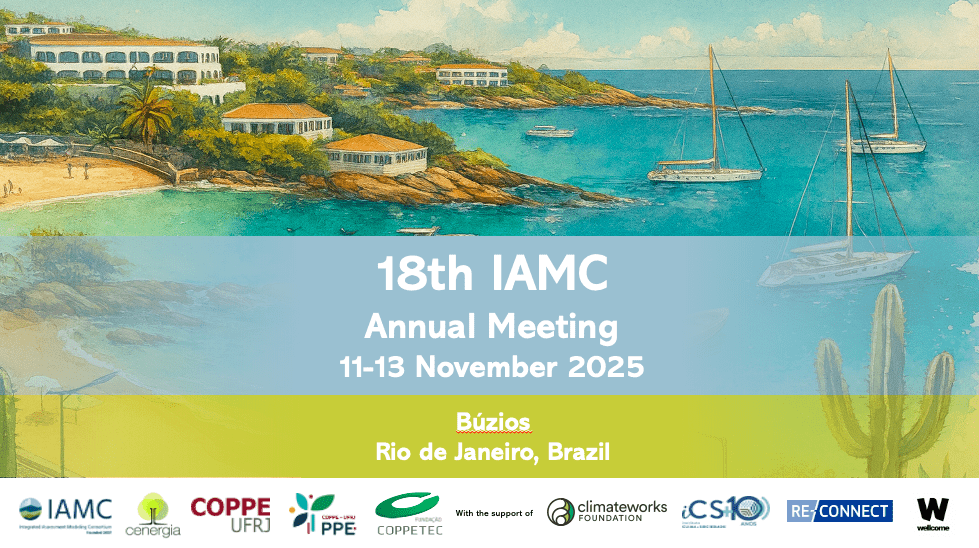
November 11, 2025 - November 13, 2025
The Integrated Assessment Modeling Consortium (IAMC) announces the Eighteenth IAMC Annual Meeting to be held on November 11-13, 2025 at Hotel Atlantico Búzios, located in the city of Armação dos Búzios, state of Rio de Janeiro, Brazil.
The event will take place in person, with a portfolio of online events as part of the programme. Presentations in oral sessions (keynote sessions, and parallel oral sessions) will be held in person, with attendance both in person and online. Centre for Energy and Environmental Economics (Cenergia/COPPE) has been entrusted by IAMC with the task of organising the event. Cenergia/COPPE is therefore the Eighteenth IAMC Annual Meeting Local Organiser.

 .
. 

with the support of




Group photo
Agenda
Overview of the Annual Meeting program.
The Online Poster Festival took place on October 28-29, 2025. Thank you to all who joined us.
Guidelines for Oral and Poster Presenters
- Instructions for oral presenters
- Instructions for online poster presenters
- Instructions for in-person poster presenters
The meeting venue, Hotel Atlantico Búzios is fully booked for the dates of the meeting. (Estr. da Usina Velha, 294 – Village de Búzios, Búzios – RJ, 28950-255, Brazil). Additional information on accommodation, local transportation, and meeting venue can be found in the logistics note (this document).Annual Meeting Purpose
The purpose of IAMC Annual Meetings is to:
- present and discuss the state of the art in integrated assessment modeling;
- review the status of ongoing community activities including both multi-model studies and the activities of the IAMC Scientific Working Groups;
- facilitate interaction with collaborating communities;
- evaluate and revisit the priorities of the integrated assessment community.
The IAMC Annual Meeting is a scientific meeting intended for peer sharing and vetting. The meeting is open to all registered participants. Researchers from organizations involved in integrated assessment modelling and their research collaborators are warmly encouraged to attend. The meeting is designed to allow researchers to share developments in methods, models and data. Participants are expected to be able to freely discuss their work.
For copyright reasons, recordings of any kind are prohibited without prior written consent of the presenter and the organisers. Attendees may not capture or use materials presented during the meeting, including unauthorised material broadcasted or made available in the Annual Meeting website by the meeting organisers, without written permission of the presenter. Views and opinions expressed during the meeting are those of the individual participants and do not necessarily reflect the official position of the IAMC or any other institutions.
For any questions, please contact the IAMC Secretariat.
Registration – only online registration possible at this time
| IN-PERSON Fee Categories | Early (until Sept 13) |
Late Fee (from Sept 14) |
| Reduced fee – Residents and Students in Low Income, Lower-Middle Income, and Upper-middle income economies (1) | € 120 | € 135 |
| Reduced fee – Students (2) | € 340 | € 405 |
| IAMC Members fee | € 400 | € 476 |
| Full fee – others | € 450 | € 540 |
In-person registration fees include coffee breaks and lunches for 11-13 November, as well as the reception in the afternoon of 11 November.
| ONLINE Fee Categories | Early (until Sept 13) |
Late Fee (from Sept 14) |
| Reduced fee – Residents and Students in Low Income, Lower-Middle Income, and Upper-middle income economies (1) | € 45 | € 54 |
| Reduced fee – Students (2) | € 140 | € 162 |
| IAMC Members fee | € 160 | € 191 |
| Full fee – others | € 180 | € 216 |
(1) Residents and students in Low Income, Lower-Middle Income, and Upper-middle income economies in accordance with the definition provided by the World Bank.
(2) Students are requested to prove their student status. You will be prompted to upload the necessary documentation.
Travel to Búzios – Official Conference Transfer Service
To reach Armação dos Búzios from Rio de Janeiro, the Local Organising Committee recommends the Official Carrier – Private Transfer Company Logística Búzios. This is a shared transfer service from Rio de Janeiro to Armação dos Búzios, operating on pre-determined dates and schedules, with seat reservations required in advance. The service is exclusive to event participants and includes specialized reception at the airports. Transfers will go directly to the event hotel, with possible stops at designated inns along the way, but without detours. The price is R$ 290.00 per passenger, per transfer.
At this link, you may book the available shared transfers from the airport to Armação de Búzios and back. The previous survey was only to explore arrival times to see if we could group travelers together. Please note that the deadline to request and complete payment for your shared transfer is November 5, 2025.
The private transfer service allows passengers to choose their preferred date and time. An executive car service (from the airports or the South Zone of Rio de Janeiro to Búzios or back) is available at a cost of R$880.00 per transfer, accommodating up to three passengers and two pieces of luggage (up to 23 kg each). Please use this link to make your reservation.
For any questions or clarification, please contact Logística Búzios:
email: buzioslogistica@gmail.com | phone: +55 21 98306 9494
Local organizer:
email: + 55 21 99557 0582 | phone: creacteve@creacteve.com.br
Other options to reach Armação dos Búzios from Rio de Janeiro are available in the logistics note.
Travel grants
The RE-CONNECT Project project and ClimateWorks Foundation provide funds to support researchers to attend the Annual Meeting. The deadline for both have expired.
RE-CONNECT Project
The RE-CONNECT Project is a 4-year-project funded by the European Commission DG Climate Action project that aims to support a range of countries on issues related to climate change modelling and transparency. RE-CONNECT will cover travel and financial assistance for selected participants attending in person and will also support virtual participation.
What’s included?
• Full travel and financial support for selected in-person attendees
• Virtual presentation/attendance options for broader accessibility
• Exclusive networking opportunities with global climate experts
• A chance to contribute to high-impact discussions on climate transparency
Please note, sponsored participants will be asked to provide a post-event mission report detailing the key insights they gained from attending the conference.
Who can apply?
This funding removes financial barriers for modelers who may otherwise struggle to attend specialized conferences. Applications for support will be reviewed, and decisions will be communicated before the early registration deadline of August 29, 2025. Some applicants requesting in-person funding may be offered virtual support instead.
How to apply
If you would like to apply for support, please complete and submit an application online by Friday 25 July. Places are limited, so be sure to provide detailed responses to strengthen your application. The deadline for submission has closed.

ClimateWorks Foundation
Participants active in the IAM field are eligible for the participation grants provided with financial support from the ClimateWorks Foundation.
The funding will help build the modelling capacity of research teams around the world and provide important insights into developments in Integrated Assessment Models (IAM).
Participation grants will be assigned according to the following priority criteria:
- Applicants with accepted papers from South America;
- Applicants with accepted papers from Africa;
- Applicants with accepted papers from countries from other middle and low-income regions*;
- Applicants without accepted papers from South America and Africa;
- Applicants without accepted papers from countries from other middle and low-income regions*;
- Students from other regions with accepted papers;
- Students from other regions without papers.
*Lists of low-income, lower-middle-income or upper-middle-income economies are based on the Gross National Income (GNI) per capita following the definition provided by the World Bank.
Grants are handled by the IAMC Secretariat and will include travel and accommodation expenses for presenting/attending in person and registration fee. Any additional costs will be covered by grantees. After the conference, supported participants will be asked to provide a mission report describing the main insights they gained at the conference.
If you would like to apply for support, please complete and submit an application online by Monday 4 August. The deadline for submission has closed.
The allocation of support will be decided and communicated before the early bird registration deadline of 12 September 2025.
Grant allocation is conditional on visa obtainment.
Visa
The IAMC 2025 Local Organising Committee will, on request, provide an invitation letter to Annual Meeting participants who need to obtain a visa. Please register to the Annual Meeting, complete the registration fee payment, and then request an invitation letter by sending your request to iamc@iamconsortium.org, together with a copy of your passport, your full affiliation and full professional address. Please do allow ample time, as the process of applying for a visa can be lengthy. All requests must be received prior to 30 September.
Call for abstracts
Abstract submissions are now closed.
The IAMC solicits abstracts for oral and poster presentations on the following selected research topics:
1. NATIONAL – Assessment of national mitigation strategies (including non-state actors). This session will focus on assessing the effectiveness and consequences of climate policies at the national scale, including the implementation of nationally determined contributions, net-zero targets and mid-century strategies. The session can also cover the contribution of non-state actors.
2. INTERNATIONAL – International climate policy.
This session focuses on the implementation of international climate policy in the context of UNFCCC, including the use of flexible instruments (Art. 6).
3. DEEP – Analysis of deep mitigation strategies.
This session will focus on (the consequences of) mitigation scenarios aimed at stringent mitigation targets consistent with the Paris Agreement.
4. OVERSHOOT – Strategies to decrease warming after an earlier peak.
This session will look at possible overshoot strategies, including the possible climate impacts of overshoot.
5. GEOPOLITICS – How does the (current) geopolitical situation influence climate policy.
This session looks into how the current geopolitical situation influences climate policy and discusses possible ways forward. Moreover, it also looks into the relationships between trade and climate policy and considerations related to security.
6. DEMAND – Efficiency, lifestyle change, sufficiency and regrowth.
This session will focus on modelling energy demand and the role of efficiency improvement. Attention will also be paid to the role of behavioral change, degrowth and its representation in IAM models. Finally, submissions may investigate the consequences of digitalization and AI.
7. TRANSPORT & BUILDINGS – Integrated assessment of pathways to carbon neutrality in the transport and building sector.
This session will look into decarbonization strategies for the two sectors, including changing mobility and housing services, improving energy efficiency, electrification, and low carbon fuel substitution.
8. INDUSTRY – Industry and Circular Economy.
Integrated assessment of pathways to carbon neutrality and circularity in industry, including in-depth analyses of industry sub-sectors and considerations of circular economy and material efficiency. Studies on changing supply chains during the transition, including associated risks and opportunities, are also invited for submission to this session.
9. ENERGY – Energy supply-sector analysis (including fossil fuels).
The section will investigate the advanced analysis of electricity and hydrogen production (including system integration) and the use of these energy carriers in end-use sectors.
10. CDR – Carbon dioxide removal and nature-based solution.
This section looks into promising carbon dioxide removal techniques (CCU, BECCS, DACS, and others) and the implications of using these.
11. LAND – Land, agriculture, and forestry.
This session will focus on strategies related to land-related sustainable development problems, including biodiversity conservation, land degradation and climate change.
12. FEASIBILITY – Feasibility and transition analysis.
This section will focus on the representation of socio-technical transitions in IAM research (including institutional change) and issues related to feasibility. Specifically, it will address how to combine insights from social-technical transition research, insights on institutional change and governance and IAM modelling. One of the relevant topics here can be dealing with different forms of feasibility (technical, economic, and social or political), enablers of effective climate policy and barriers.
13. ECONOMY – Economic analysis and climate finance.
This section focuses on the economic aspects of mitigation and adaptation strategies and risks associated with climate impacts. This also includes climate finance. But also integrated approaches to mitigation, adaptation, and impacts together.
14. IMPACTS – Impacts of climate change (including representation of the climate system).
This session will focus on modelling climate impacts in integrated assessment models. Special attention will be paid to the representation of adaptation in IAMs. Impacts of climate change, such as those on agriculture, energy systems or wider. The session will also look into the representation of the climate system itself (including small climate models and emulators).
15. BIODIVERSITY – Modelling biodiversity and ecosystems services.
This session will look into the use of IAMs for assessing trends in biodiversity and the provisioning of ecosystem services.
16. CITIES – Cities and climate mitigation, adaptation and impacts.
This session will look into the possible impacts of cities on climate change and their role in mitigation and adaptation. The session will also consider climate impacts on cities.
17. CLIMATE – Representation of climate, air pollution and carbon cycle in IAMs.
This session discusses the representation of climate and air pollution in IAMs, but also specific strategies to deal with air pollution and forcing from short-lived climate forces.
18. DISRUPTIONS – Representation of possible disruptive events in models and scenarios.
In most cases, IAMs focus on gradual trends in human activities and the earth system. Disruptive events, however, may have significant impacts on the future. This session will focus on the representation of possible disruptive events in models and scenarios.
19. WELLBEING – Human wellbeing and health.
This session will focus on the representation of human wellbeing and health in IAMs.
20. SUSTAINABLE – Sustainable development.
This section will focus on the assessment of Sustainable Development Strategies, including scenarios aiming to reach multiple SDGs and analysis of the energy-water-land nexus.
21. JUSTICE – Climate justice (including equity and distributional impacts).
Analysis of distributional aspects of mitigation strategies (both at the international and national scale) and the development of just transition strategies. The support for mitigation strategies often depends on the (perceived) fairness of strategies. In this session, we will look into the distributional and fairness aspects of mitigation strategies related to IAM analysis.
22. CRITICAL MATERIALS – Critical minerals and materials (CMMs).
The energy transition will require demand of all kinds of (critical) materials. This session will look into this relationship and possible consequences for the energy transition.
23. POLICY – Policy instruments and policy analysis.
This session will focus on the representation of policies in IAMs and the analysis of the impact of different policy instruments.
24. METHODS – Methodological advances in IAM research (including use of AI, open science and stakeholder interaction).
This session will specifically look at various methodological issues related to IAMs, including open science and uncertainty analysis. This may also involve model validation, programming languages presentation tools, model solvers, representation of complex policies and model evaluation.
25. SSPs – SSPs and other scenarios.
This session is looking for updates and extensions of the SSP scenarios in various areas and across scales, such as developing national and regional scenarios and their association with appropriate SSP domains. At the same time other new scenarios and focus on the representation of shocks are also welcome.
Submission Guidelines on Oxford Abstracts
Follow the two steps below to create your Oxford Abstracts account and submit your abstract.
Step 1: Create an Oxford Abstracts account (if you don’t already have one)
- Create an Oxford Abstracts account with your email address (please use your institutional email address) and a password.
- Check your email for a verification message from Oxford Abstracts. Click the ‘Verify Email’ button in the email to confirm your address.
- Once your account is successfully created, you will receive a generic message prompting you to visit the conference website. Enter the IAMC 2025 Annual meeting Submission Form link into your browser to access the submission form.
Step 2. Complete the IAMC 2025 Annual Meeting submission form
After creating your Oxford Abstracts account, you will be able to submit an abstract for consideration at the Annual Meeting.
- Follow this link to the IAMC 2025 Annual Meeting submission form
- Complete and submit your form.
Once you have filled out all required information and uploaded your long abstract, click ‘Submit’ in the bottom right corner. You will then be able to review your submission details.
If you need to make changes, click ‘Amend’ in the top right corner to return to the form for editing. When all fields are complete and you are satisfied with your submission, click ‘Submit’ to finalize it.
Please note:
If you do not complete all required fields, your submission will be marked as “incomplete” and will not be considered. In this case, you will receive an email notification informing you that your submission is incomplete. You will have until the submission deadline (22 May 2025) to complete your submission.
To complete it, log back into your Oxford Abstracts account, fill in all required fields, and submit your form.
How do I know if my submission is complete and will be considered?
You will receive a confirmation email called “IAMC 2025 – Successful submission” to the email address connected to your Oxford Abstracts account when your submission is complete.
Submission Requirements
- You must submit a short abstract (maximum 300 words) AND upload a long abstract of your paper as a pdf.
- The long abstract should include 600-1000 words and 1-3 figures, as well as a summary with a maximum of 100 words. Please ensure that the methodological approach and results of the study are sufficiently well described. The pdf file size limit is 10MB.
- Multiple submissions are allowed. It is, however, good practice in IAMC Annual Meetings to accept only one talk per person (in case a selection needs to be made).
- A co-authored paper/abstract should be submitted by only one of the authors.
- Only the individual submitting the paper will receive notification regarding accepted papers.
Editing your Submission
You can edit your submission details at any time prior to the closing date for submissions (15 May 2025). If you need to make a change, you will need to:
- Log back into your Oxford Abstracts account.
- Click on the ‘Edit’ button next to your submission. This will take you to the submission form and you can edit any fields you would like to change.
- At the end, click “Submit”.
Withdrawing your submission
To withdraw your paper, email us at iamc@iamconsortium.org. Once your request is processed, you will receive a confirmation email.
Please note that once your submission is deleted, it cannot be retrieved. If you decide to resubmit after withdrawal, you must start the submission process from the beginning, as long as the submission deadline has not passed.
Information
For any questions, please contact the IAMC Secretariat.